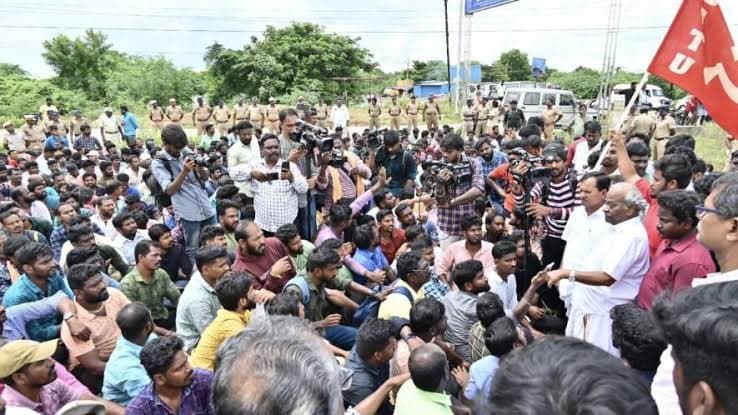
THOOTHUKUDI/CHENNAI — Seven years after the tragic police firing that claimed 13 lives and led to the shuttering of the Sterlite Copper plant, the gates of the Thoothukudi Collectorate were once again swarmed by thousands. But this time, the demand was a desperate plea for economic survival.
To understand this complex, multi-layered crisis, here is a breakdown of the core journalistic facts:
Who: Thousands of local residents (including contract workers, women's self-help groups, and auto drivers), Vedanta Limited, the Tamil Nadu Pollution Control Board (TNPCB), and the Madras High Court.
What: A massive grassroots protest demanding the reopening of the defunct smelter, running parallel to Vedanta's legal petition to restart operations under a "Green Copper" framework.
Where: The protests occurred at the Collectorate in Thoothukudi, while the legal battle unfolded at the Madras High Court in Chennai, Tamil Nadu. (cover image: The Human Cost: Thousands rally for their lost livelihoods.. Source: NewsClick)
When: The most recent surge of protests and legal hearings took place on Monday, marking a renewed push in a seven-year stalemate since May 2018.
Why: Locals are fighting for their lost livelihoods, and Vedanta is seeking to capitalize on India's critical need for domestic copper. However, the state remains hesitant due to a grim history of environmental degradation and fatal protests.
How: Locals mobilized to submit petitions to the District Collector, while Vedanta approached the courts citing scientific panel recommendations, proposing to use copper scrap instead of raw ore to bypass previous pollution issues.
The Human Cost: Economic Survival vs. Ecological Memory
On Monday, thousands from villages including Tsunami Nagar, Saminatham, and Pandarampatti gathered outside the Collectorate at 8:00 a.m.
For these residents, the immediate threat of poverty has eclipsed the memory of pollution. Petitioners noted that over 150 individuals from Tsunami Nagar alone lost their jobs when the plant closed. Forced to seek low-paying alternative work, many are struggling to feed their families or afford basic education.
"To protect people’s livelihood and provide employment, the Sterlite plant must be reopened. We will vote only for the party that supports reopening." — Slogan chanted by the protesting workers.
The Legal Tug-of-War in Chennai
While workers petitioned the Collector, Vedanta Limited moved the Madras High Court to challenge the TNPCB, which recently rejected its application to restart the plant. Vedanta is proposing a pivot to Green Copper—producing copper from scrap and waste rather than raw ore.
The courtroom saw tense exchanges regarding the company's track record:
The Court's Stance: The bench noted that Vedanta’s environmental background "seems to be haunting."
Vedanta's Defense: Senior advocate Satish Parasaran argued for a second chance, stating, "Every saint has a past, and every sinner should have a future."
The State's Pushback: Additional Advocate General J Ravindran dismissed the proposal as "old wine in a new bottle," arguing the site is already a "contaminated area."
The National Sacrifice and Global Context
The 2018 shutdown of Thoothukudi didn't just impact Tamil Nadu; it rattled the national economy.
Before the closure, the Sterlite plant produced roughly 40% of India's total copper output.
Overnight, India transformed from a net exporter of copper to a net importer.
As the world races toward renewable energy and electric vehicles (EVs), copper is the critical underlying resource. Nations like China and the US are rapidly expanding smelting capacities. Without domestic production, India remains vulnerable to global supply chain shocks.
The Science of Smelting: What Actually Went Wrong?
To understand the resistance, one must look at the science of traditional copper extraction and why it faces global pushback.
Extracting copper from raw ore involves superheating sulfide minerals. This metallurgical process inherently emits massive quantities of Sulfur Dioxide. (cover image 2: Sulfur burning with a blue flame, emitting sulfur dioxide gas.. Source: National Geographic)
The Toxic Chain Reaction
Atmospheric Danger: If not captured by highly efficient scrubber systems, Sulfur Dioxide escapes into the atmosphere.
Acid Rain: It reacts with water and oxygen to form sulfuric acid, leading to acid rain that degrades local soil and pollutes groundwater.
Health Hazards: Inhalation of Sulfur Dioxide causes severe respiratory distress and long-term lung disease.
It was the persistent complaints of toxic gas leaks and choking air that fueled the massive 2018 protests.
A Legacy of Rejection
The skepticism surrounding Vedanta is historical. Long before Thoothukudi, Sterlite attempted to set up this exact smelter in Ratnagiri, Maharashtra, in the early 1990s. Massive agitation by local farmers over coastal pollution forced the government to cancel the project. Globally, multinational mining corporations frequently face accusations of environmental violations, particularly in developing regions where industrial expansion outpaces ecological compliance.
As the Madras High Court prepares for detailed responses by late February, Thoothukudi remains caught between a desperate need for jobs, a national demand for green infrastructure, and the haunting memory of an ecological disaster.